
Find Pennsylvania Deed Records
Pennsylvania deed records are public documents maintained by the Recorder of Deeds in each of the state's 67 counties. These records cover property transfers, mortgages, easements, and other instruments affecting real estate across the commonwealth. You can search and obtain Pennsylvania deed records online through the statewide portal, by visiting a county recorder office in person, or through the Pennsylvania State Archives for older historical land records. This guide covers where to look and how the system works.
Pennsylvania Deed Records Quick Facts
Pennsylvania Land Records Overview
Pennsylvania is divided into 67 recorder districts. Each has an elected Recorder of Deeds who is responsible for accepting, indexing, and maintaining all documents related to real estate ownership in that county. When a deed is recorded, it is assigned a sequential identifying number called the book and page number. The recorder's staff scans the document into the office computer system, and images become available at public access terminals and over the internet. Original documents are returned to the property owner after recording in most cases.
Recorder offices create a searchable index that lists all parties to a document along with the property address. This index allows anyone to look up a deed by the grantor's name, the grantee's name, or the property location. Most offices also microfilm all recorded documents and continue to produce bound record books. The index serves as legal notice to the public that a transfer has occurred, which is the foundation of Pennsylvania's recording system.
All 67 county recorders are members of the Pennsylvania Association of Recorders of Deeds (PRODA). The association sets recording standards and best practices that apply across all member offices. Recorder offices also act as agents for the collection of the state realty transfer tax at the time each deed is submitted for recording.
Note: County recorder offices are the official source for private deed records; state archives hold original land patents and warrants from the period before private ownership.
Pennsylvania State Archives and Deed Records History
The Land Office of the Commonwealth has operated without interruption since William Penn arrived in Pennsylvania in 1682. That makes it one of the oldest continuously operating land record systems in the country. In 1981, the land records and functions of the Land Office were transferred to the Pennsylvania Historical and Museum Commission (PHMC), which now oversees the State Archives. Commonwealth land records document the initial transfer of land from the Penns or the post-revolutionary Commonwealth to the first private purchasers of each tract. Deeds transferring land between private citizens after that first sale are not held by the state. Those records live at the county Recorder of Deeds office.
The Pennsylvania State Archives land records overview explains the distinction between state-held warrants and patents versus privately recorded deeds.
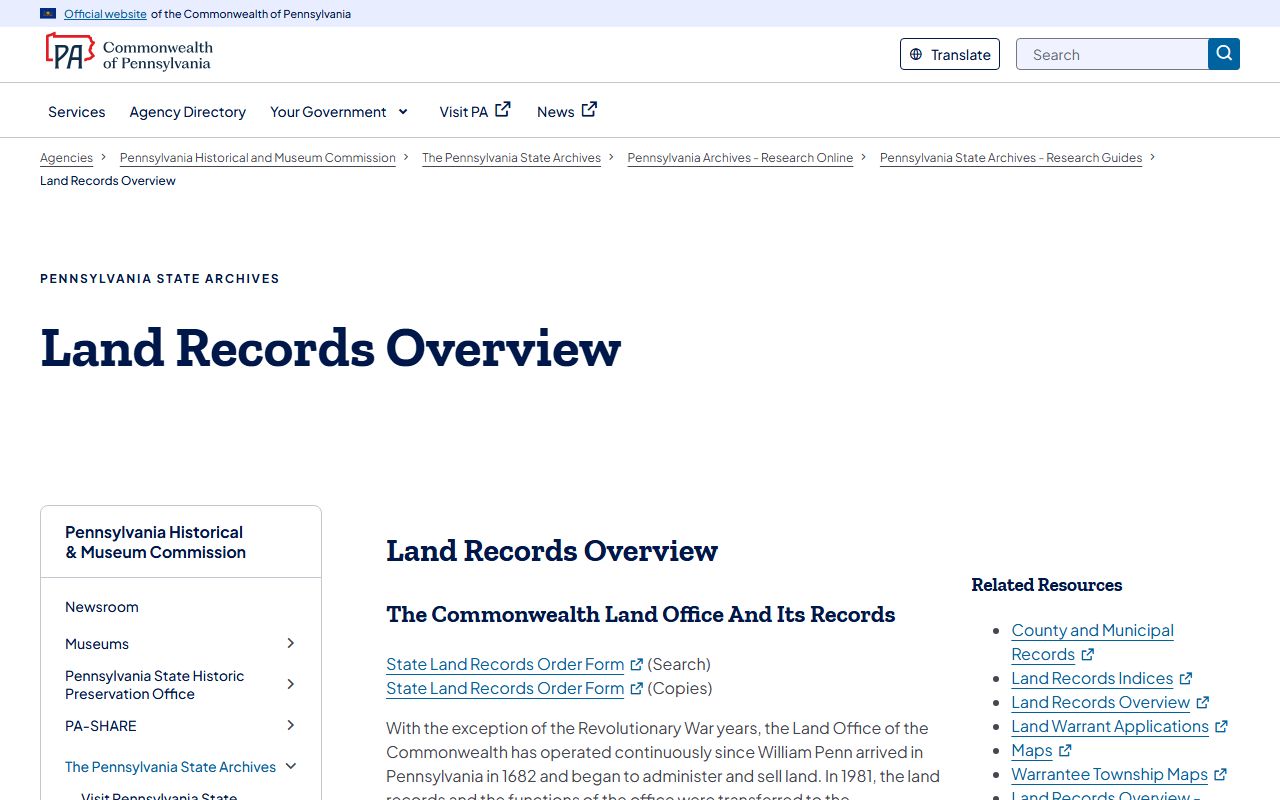
The archives hold land warrant applications dating from 1735 and provide digitized access to many early records through their online research tools.
It is worth noting that no federal land grants were ever issued in Pennsylvania. All original land titles flow through the Penn family or the Commonwealth. When researching an older property, you will want to identify the full name of the original land purchaser, the county where the land was located, and the approximate date of the transaction. The State Archives also maintains a Genealogical Map of the Counties that shows which current counties and municipalities were created from earlier ones, which is important when searching old deeds.
The State Archives research room is located at 1681 N. Sixth Street, Harrisburg, PA 17102. Research hours are Wednesday through Friday from 9:00 a.m. to 4:00 p.m. and Saturday from 9:00 a.m. to noon and 1:00 p.m. to 4:00 p.m. The archives also provide digitized microfilm copies of some county deeds for visitor convenience, though staff can only conduct searches in records for which they hold the original copies.
Searching Pennsylvania Deed Records Online
Pennsylvania's primary deed records gateway, pa.uslandrecords.com, provides access to all 67 county recorder districts from a single portal.
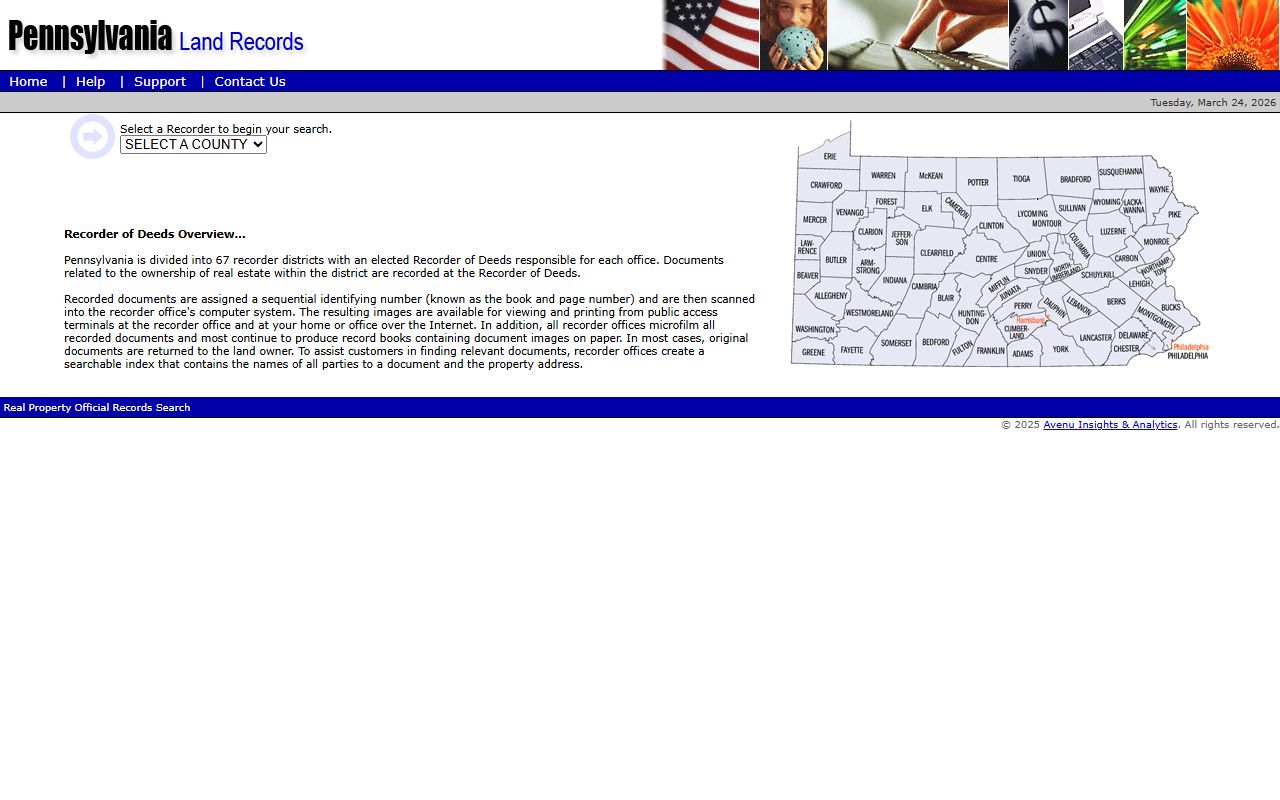
The portal connects users to each county's recording system, where documents are searchable by grantor and grantee names, property address, and document type.
Once you select a county on the portal, you can search by the name of the buyer (grantee) or seller (grantor), by book and page number, or by property address. Most county systems display the document image directly in your browser at no charge. Some counties offer a subscription service that gives additional features or bulk access for title searchers and attorneys who use the system often. The free public access option covers the needs of most individual searchers.
Each recorded document carries a book and page number that serves as its permanent identifier in the county system. If you are searching for a specific deed, having that number will get you to the document quickly. If you do not have a book and page number, a name search on the grantor or grantee index is the standard starting point. Results will show all documents indexed under that name along with the document type, recording date, and book and page reference.
Pennsylvania Deed Recording Requirements
Documents submitted to a Pennsylvania recorder office must meet specific standards before they will be accepted. The document must be an original. Copies are not accepted for recording. Every deed must include an acknowledgment signed before a notary public. The acknowledgment must state the county, state, and date, and it must include the names and titles of the persons who appeared, along with the notary's signature, seal, and commission expiration date. The acknowledgment date cannot be earlier than the date on the deed itself.
The Pennsylvania Association of Recorders of Deeds (PRODA) sets recording standards and provides a fee calculator for all 67 member offices.
PRODA publishes document standards that apply across all county recorder offices, ensuring consistency in how deeds are accepted and processed.
Under 16 P.S. § 9781, the recorder of deeds must refuse a deed for recording unless a certificate of residence for the grantee is attached. The certificate states the grantee's correct address and must be signed by the grantee or a signatory acting on the grantee's behalf. Some counties require two addresses: one for mail and one for the tax bill. This requirement applies to all deeds submitted anywhere in Pennsylvania.
Pennsylvania law under 21 P.S. § 402 authorizes counties to implement a Uniform Parcel Identifier (UPI) system. Many county recorders will not accept a deed without a UPI number issued by the county Assessment Office. The deed must also indicate the municipality, county, and state where the property is located. Numerical amounts must match the written amounts on the document. Transfer taxes or a completed Statement of Value form must accompany all transfers. A stamped, self-addressed envelope must be included with every recording so the original can be returned.
The Pennsylvania Department of State notary search lets you verify notary commissions on recorded documents, an important step when authenticating deed acknowledgments.
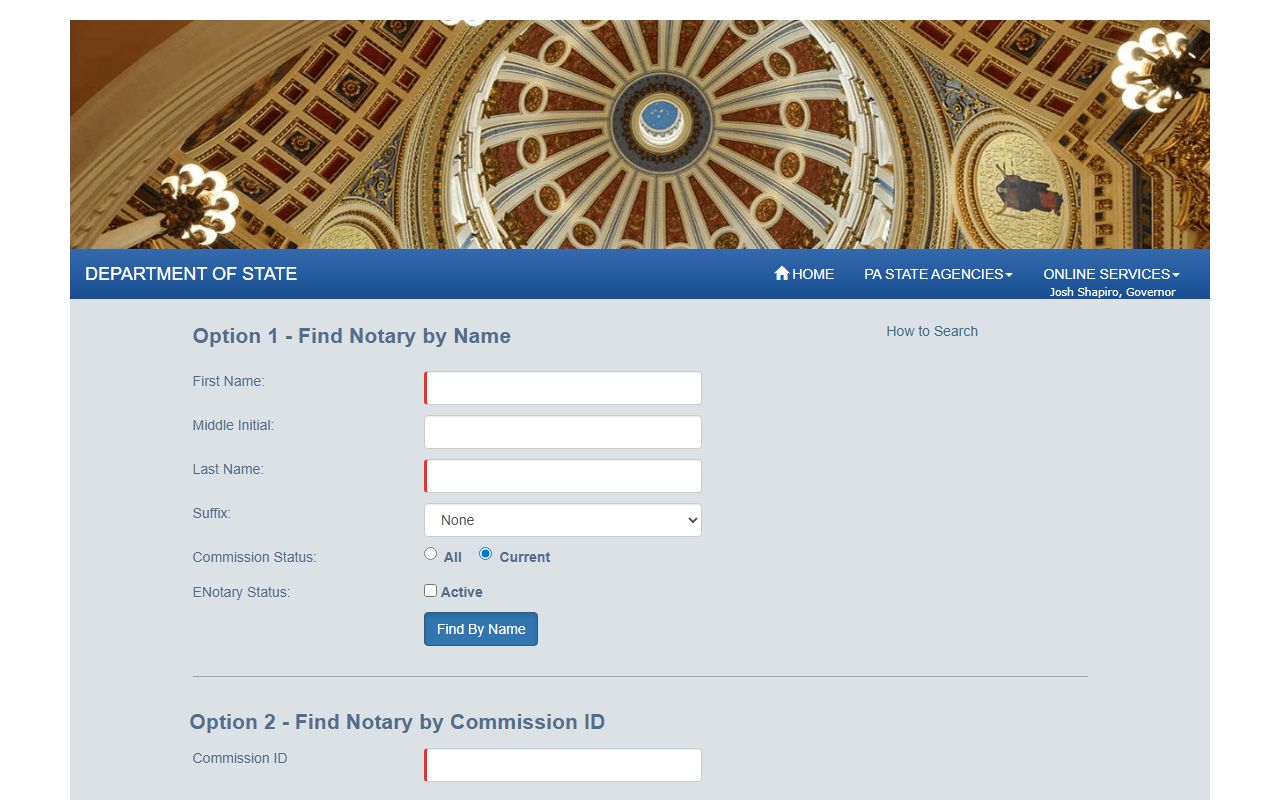
Notaries must record their oath with the Recorder of Deeds in the county where they conduct business, and must register their signature with the county Prothonotary.
Note: Military discharge papers (DD214s) recorded with the Recorder of Deeds are NOT public record and cannot be accessed through standard deed record searches.
Pennsylvania Deed Records and Realty Transfer Tax
Every deed recorded in Pennsylvania triggers a realty transfer tax. The state rate is 1% of the property value under 72 P.S. § 8102-C. Local political subdivisions add their own rate on top of the state rate. Most localities add another 1%, bringing the combined total to 2% for many transactions. However, some cities apply higher rates. Philadelphia charges a local rate of 3.278%, making the total tax in the city over 4%. Pittsburgh's local rate is 4.00%.
The State Tax Equalization Board (STEB) calculates Common Level Ratio factors for each county, published annually in the Pennsylvania Bulletin.
These factors determine the basis for realty transfer tax calculations when property changes hands in each Pennsylvania county.
Form REV-183, the Realty Transfer Tax Statement of Value, is required for most property transfers. The tax is calculated on the greater of the actual consideration paid or the assessed value multiplied by the Common Level Ratio factor. Under 72 P.S. § 8107-C, the Department of Revenue has authority to set regulations governing the tax, and the recorder of deeds is required to cross-reference the Statement of Value with the deed book volume and page when processing a recorded document. Certain transfers are exempt from the tax, including transfers between spouses, transfers to children for no consideration, transfers between siblings and their spouses, transfers from an estate to beneficiaries, and transfers to government entities.
Fifteen percent of gross realty transfer tax collections go to the Keystone Recreation, Park and Conservation Fund. The Pennsylvania Housing Affordability and Rehabilitation Enhancement Fund also receives a portion of transfer tax proceeds. The recorder of deeds acts as the collection agent at the time of recording, and the proceeds flow to both state and local funds based on the applicable rates.
Pennsylvania Deed Recording Act and Public Access
Pennsylvania follows a race-notice recording system under 21 P.S. § 351. A deed that is not recorded is void against any later buyer or lender who pays value and has no notice of the earlier unrecorded deed. The rule protects buyers who conduct a proper title search and rely on the public record. To win a race-notice dispute, a subsequent purchaser must record first and must have had no actual or constructive knowledge of the prior unrecorded deed.
Pennsylvania's Unified Judicial System portal provides access to court records that may accompany property-related legal proceedings.
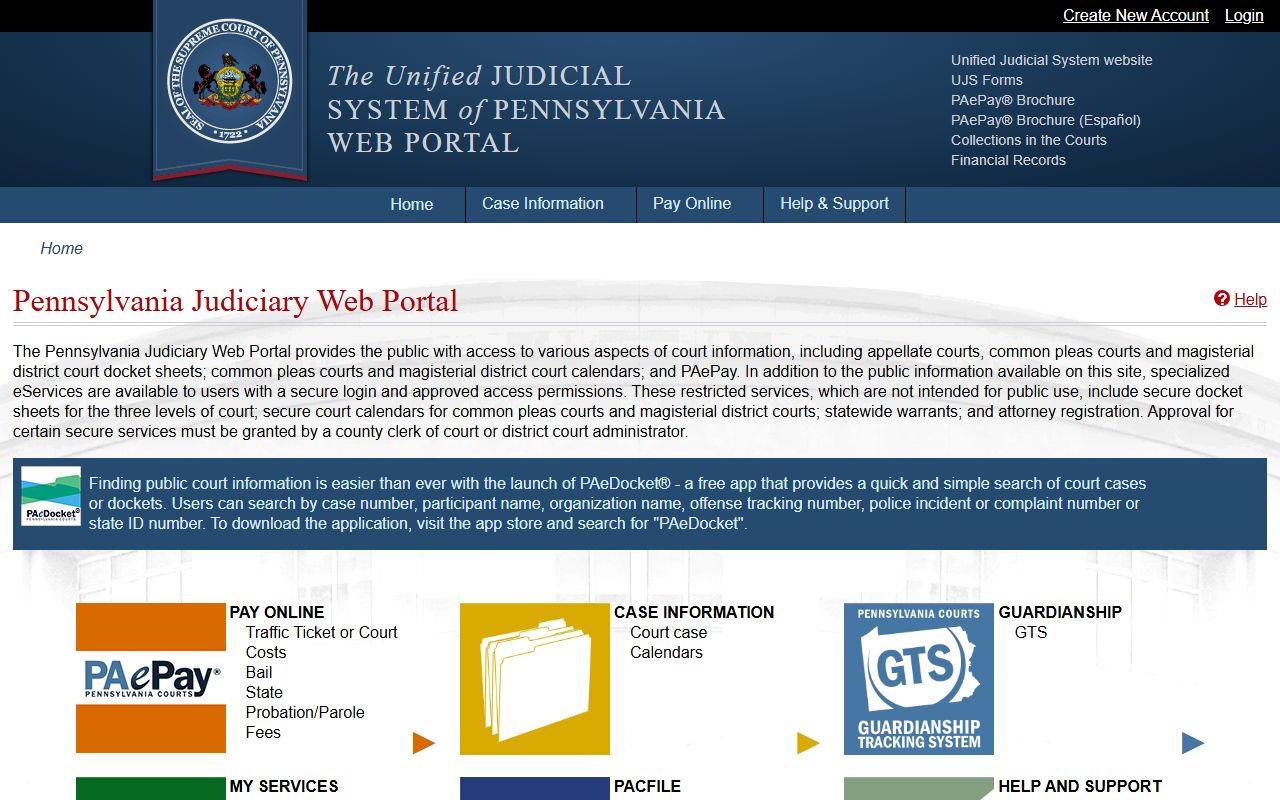
The portal covers Court of Common Pleas records statewide and is useful when researching property disputes, foreclosures, or liens that may affect a deed.
Under 21 P.S. § 444, a deed must be recorded within 90 days of execution. Failure to record within that window makes the conveyance fraudulent and void against subsequent creditors of the grantor. The 90-day rule works together with Section 351 to protect against situations where a seller might appear to still hold title when they have already sold the property. Recording promptly is the best way to protect any buyer's interest in Pennsylvania.
Deed records are public under the Right-to-Know Law, 65 P.S. § 67.101. Any person may inspect or copy a deed without showing a reason or interest. Agencies must respond to written requests within five business days. There is no requirement to be a party to the deed or have any connection to the property. All recorded deeds in Pennsylvania are open to the public as a matter of law.
The Pennsylvania Unified Judicial System public records page provides aggregate court data and access to case information across all state courts.
Docket sheets for Court of Common Pleas cases are available online and include any property-related judgments or orders that may create liens on real estate.
Historical Pennsylvania Deed Records and Genealogy Research
The Pennsylvania State Archives collection highlights include land warrants dating from 1733 through 1987, all digitized and searchable online.
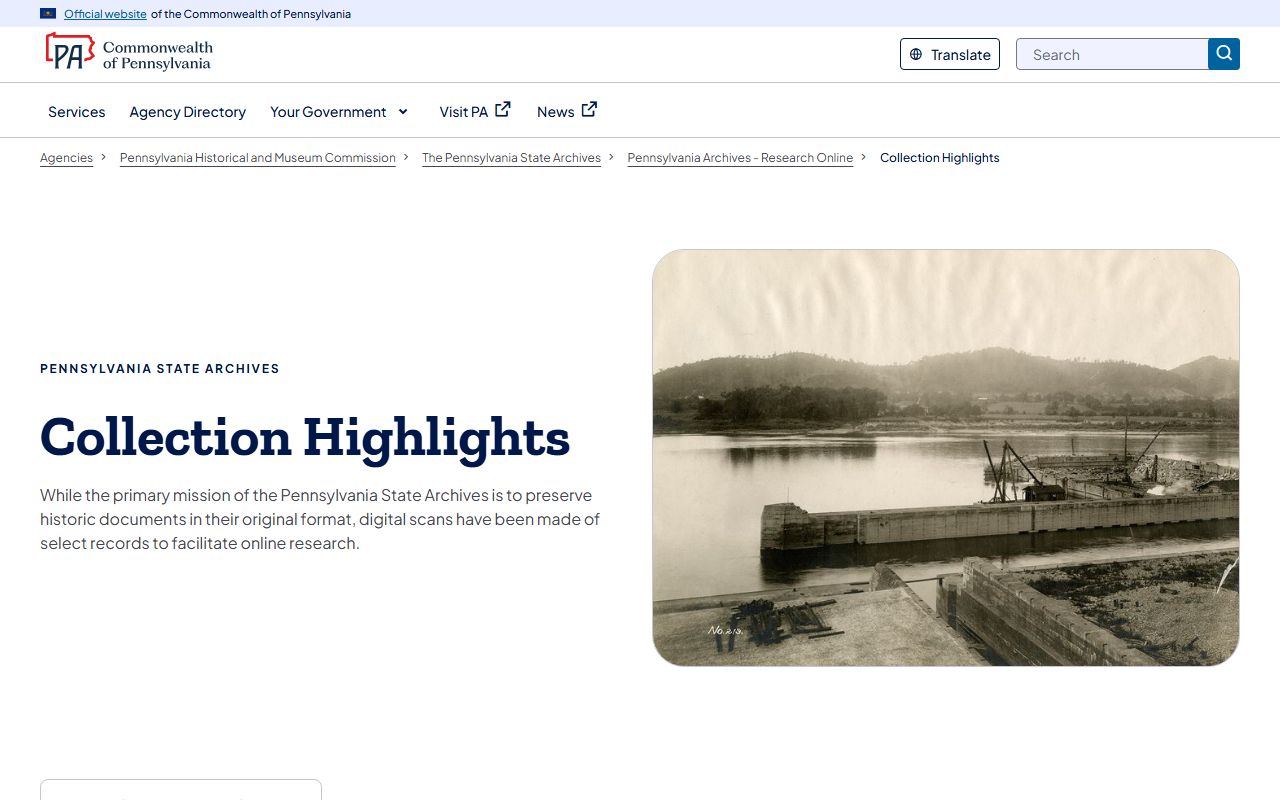
The Ancestry.com partnership makes many of these records free for Pennsylvania residents who access the collection through the State Archives' portal.
The State Archives holds warrant registers covering the years 1733 through 1957. These registers document about 70% of all land transferred from the Commonwealth to private owners. They are arranged by county at the time of warrant, then by surname, and then by date. Each entry contains information on the warrant, the survey, and the patent. The Old Rights Index for Bucks and Chester Counties covers the period from 1682 to 1740, and the Philadelphia Old Rights Index covers 1682 to 1745. The Original Purchases Register from 1687 to 1762 lists First and Late purchasers of land from the Penn family. These are core resources for anyone tracing property back to colonial times in Pennsylvania.
Pennsylvania's land records indices cover warrant registers for all 67 counties organized by surname and date of warrant.
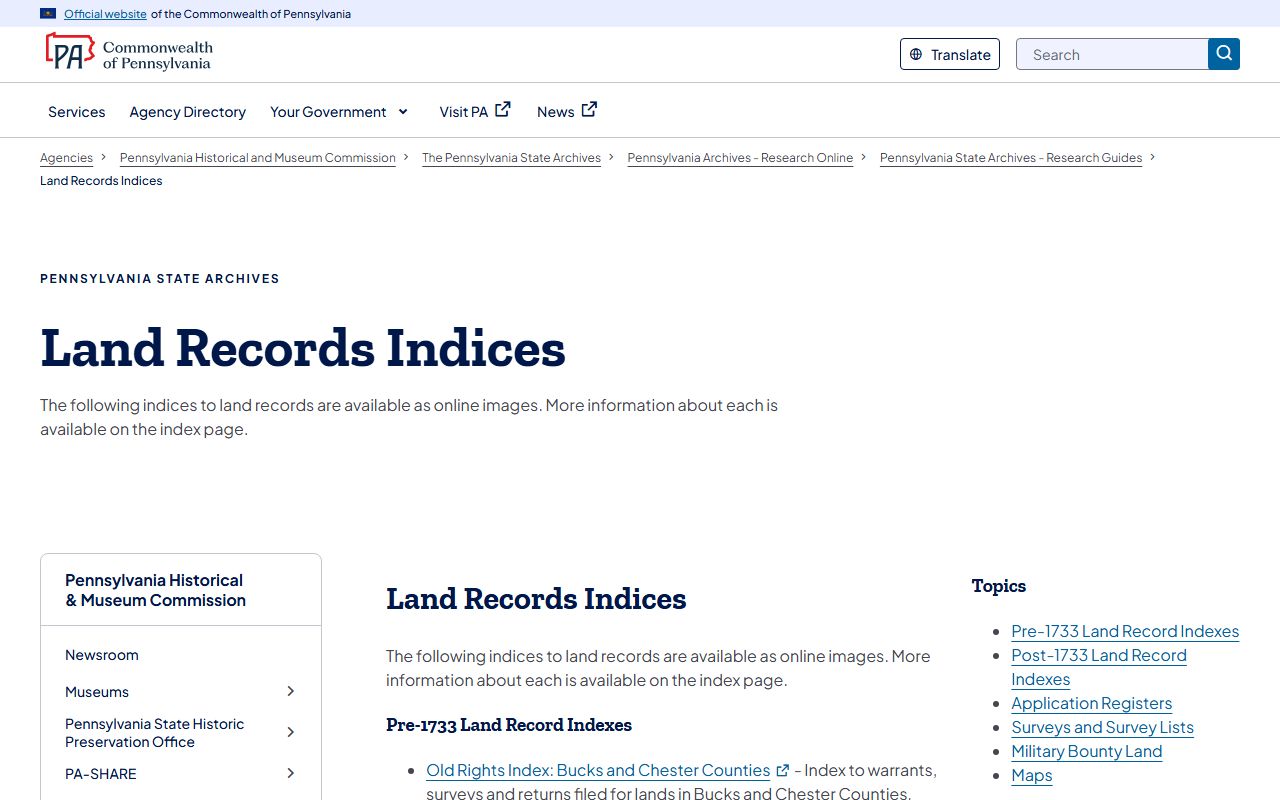
These indices include warrantee township maps for about 30 percent of the state's townships and connected draft maps organized by county.
Land warrant applications are available online through FamilySearch.org. An application was a request to purchase land from the State government. Successful applicants received a land warrant from the State Land Office. These applications are filed in Record Group 17 at the Archives and contain the name of the applicant, a general description of the tract location, the acreage, and the names of bordering property owners. Applications submitted after 1795 typically include the applicant's signature and settlement details. This level of detail makes them valuable for genealogical research in Pennsylvania deed records.
Researchers who cannot travel to Harrisburg can submit requests through the State Land Records research service to have staff search original records on their behalf.
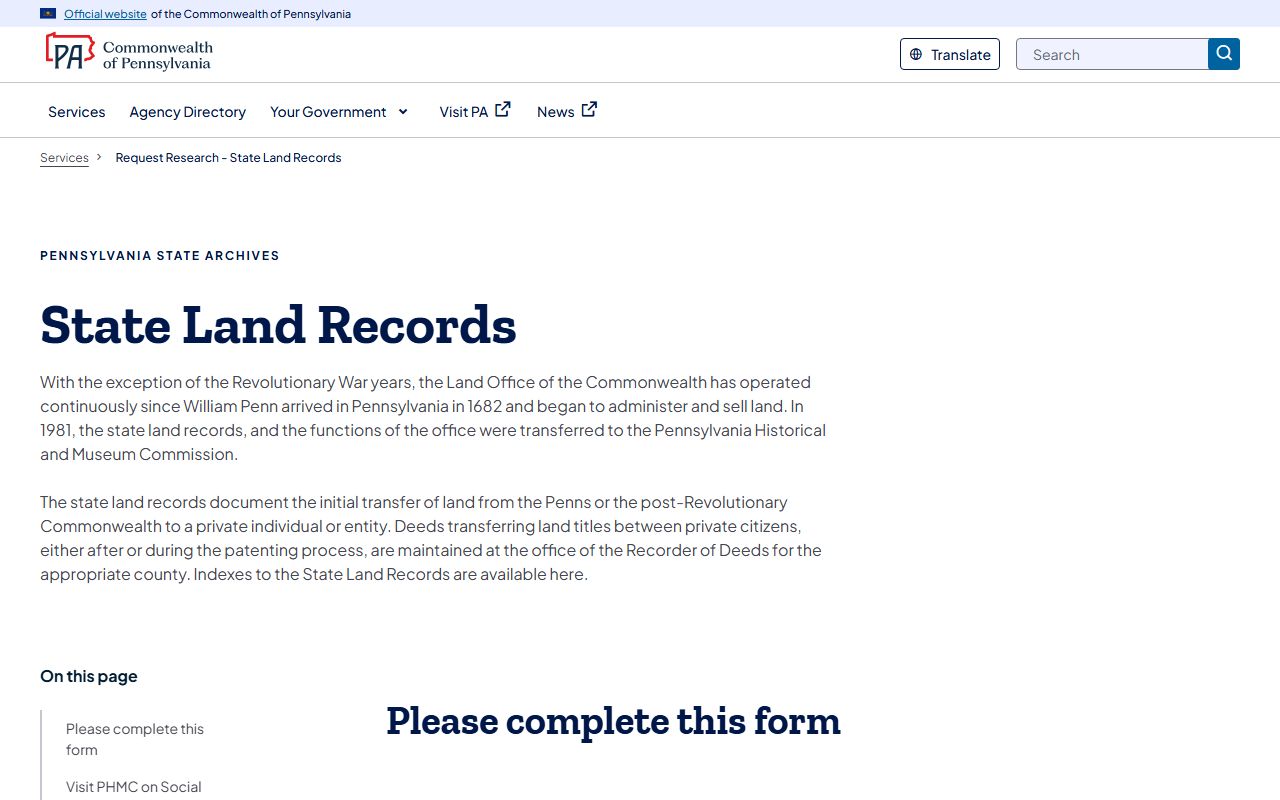
This service applies only to original records held by the Archives -- staff cannot search microfilmed county records or federal censuses.
The Department of State business entity database covers more than 2.4 million companies authorized to do business in Pennsylvania, useful when verifying corporate grantors or grantees named in a deed.

All business entity records are public and searchable by entity name or entity number at no charge.
Browse Pennsylvania Deed Records by County
Each of Pennsylvania's 67 counties maintains its own deed records through the elected Recorder of Deeds office. Select a county below to find specific resources, contact information, and online search options.
Pennsylvania Deed Records by City
Major Pennsylvania cities file deed records at their county recorder's office. Find local resources for deed record searches in each city below.