
Elk County Deed Records
Elk County deed records are kept by the Recorder of Deeds office in Ridgway, the county seat in north-central Pennsylvania. The office maintains all land records and property documents for Elk County. Searching these records gives you access to the history of property ownership, mortgages, easements, and other recorded instruments. Records are available at the courthouse in Ridgway and through the statewide Pennsylvania land records portal online.
Elk County Quick Facts
About Elk County Deed Records
Elk County was created in 1843 from parts of Jefferson, McKean, and Clearfield counties. The county takes its name from the elk that once roamed the region, and the area remains known today for its forests, wildlife, and outdoor recreation. The Recorder of Deeds has maintained land records for the county since its founding, creating a continuous archive of property ownership going back more than 180 years.
All deeds for Elk County property must be recorded with the Recorder of Deeds under 21 P.S. § 351. Recording creates a public record that establishes ownership and protects the buyer against later claims. Each document receives a book and page number, is scanned into the county's system, and is preserved on microfilm as a permanent backup. These records form the legal chain of title for every piece of property in Elk County.
Elk County deed records reflect the county's history of timber, tanning, and mining industries. Many older records include timber rights conveyances, mineral rights agreements, and deeds with restrictions tied to industrial activity. The county's rural character means that many parcels are large and that boundary descriptions in older deeds may reference natural landmarks and survey monuments that require a surveyor to locate today.
Elk County Recorder of Deeds
The Elk County Recorder of Deeds is located at the Elk County Courthouse in Ridgway. Office hours are Monday through Friday during normal business hours. It is advisable to call the office before visiting to confirm current hours and any requirements for document submission. Because Elk County is a smaller county, the Recorder's office may have limited staff, so calling ahead helps ensure you get prompt service.
In-person searches at the Ridgway courthouse can be done by grantor or grantee name, book and page number, instrument number, or date range. Staff can locate documents and provide copies for a fee. Certified copies of recorded instruments are available upon request. The Recorder's office staff cannot give legal advice, perform title searches, or tell you if a specific parcel is free of liens. Those questions require a licensed title company or attorney.
| Office | Elk County Recorder of Deeds |
|---|---|
| Address | 250 Main Street, Ridgway, PA 15853 |
| Phone | 814-776-5349 |
| Online Search | pa.uslandrecords.com |
Searching Elk County Deed Records Online
The Pennsylvania statewide land records portal at pa.uslandrecords.com provides the most reliable online access to Elk County deed records. Pennsylvania covers all 67 recorder districts through this portal, and Elk County is included. Searching by party name, document type, or date range lets you find most recorded instruments without traveling to Ridgway.
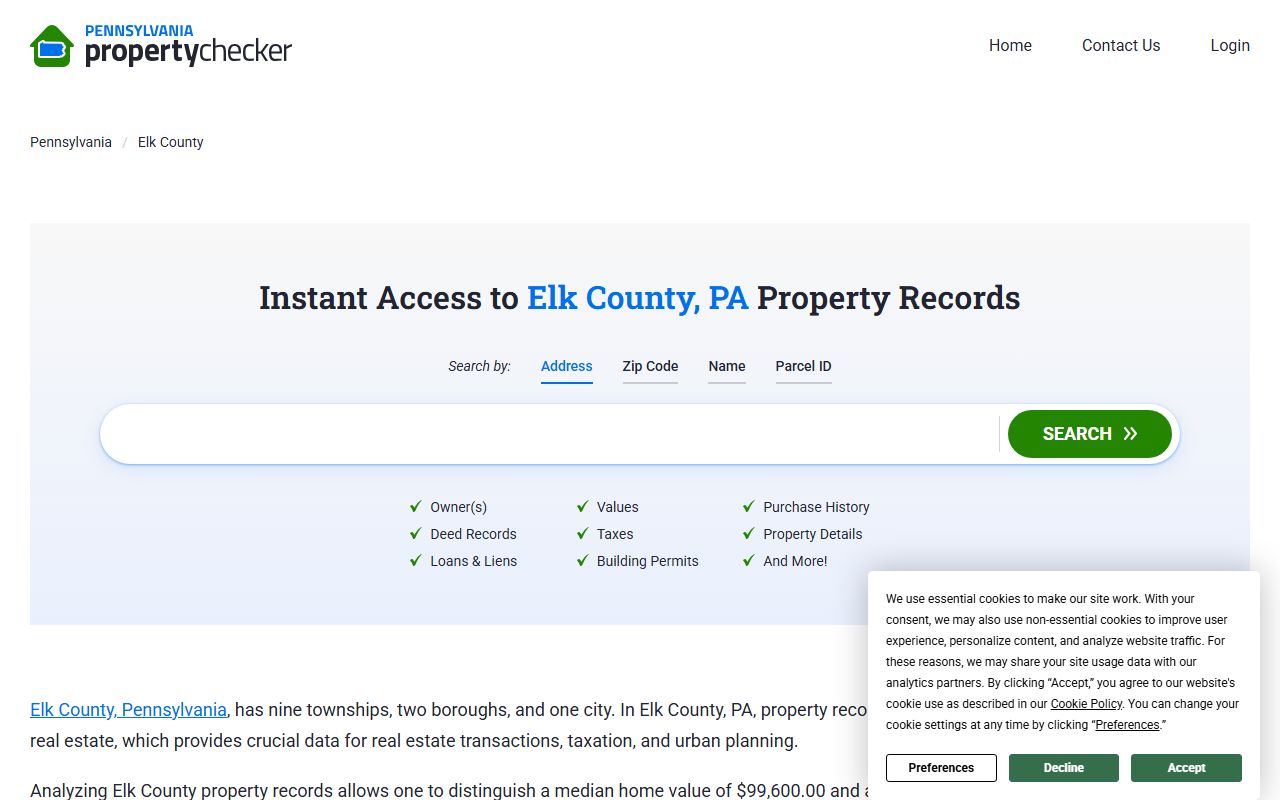
The image below is from a property records resource for Elk County, showing the type of land data available through online searches.
Third-party tools such as NETROnline provide links to assessor and recorder resources for Pennsylvania counties including Elk County. The Pennsylvania Association of Recorders of Deeds also maintains a county officials directory and a fee calculator at padeeds.com/fee-calculator that can help you estimate costs before submitting documents for recording.
Note: For smaller counties like Elk, the statewide portal is often the most practical option for remote deed record searches.Elk County Recording Requirements
Documents submitted for recording in Elk County must meet Pennsylvania's standard requirements. Each deed must include a full legal description, the names of all parties, a notary acknowledgment, and a Uniform Parcel Identifier (UPI). The UPI requirement under 16 P.S. § 9781 links each deed to the county's tax parcel map. A deed without a valid UPI will not be accepted for recording.
Pennsylvania's realty transfer tax of 1% applies to most transfers in Elk County. Local municipalities may impose additional local transfer taxes. Form REV-183, the Realty Transfer Tax Statement of Value, must accompany every deed. Some transfers qualify for exemptions, including direct family line transfers, trusts, and charitable conveyances. Visit the Pennsylvania Department of Revenue at pa.gov for current rates and a complete list of exemptions. Any notary whose acknowledgment appears on a recorded deed can be verified at notaries.pa.gov.
Historical Land Records in Elk County
Elk County's land history is closely tied to the vast forests and resources that drew settlers to north-central Pennsylvania in the 19th century. The earliest property transactions often involved large tracts transferred from speculators to timber companies or to settlers who cleared the land for farming. These historical patterns show up in Elk County deed records as grants, timber easements, and mineral rights separations that can make modern title research more complex.
For researchers tracing Elk County property back to its original grant, the Pennsylvania State Archives holds land warrant registers and warrantee township maps for the region. The Archives' research guides at pa.gov/agencies/phmc explain how to identify original warrantees and connect early land grants to the modern parcels recorded in the Elk County deed books. These historical records predate the county's 1843 founding and often trace through Jefferson, McKean, or Clearfield county records depending on where the land sat at the time of the original grant.