
Search Allegheny County Deed Records
Allegheny County is home to Pittsburgh and is the second-largest county in Pennsylvania by population. The Allegheny County Recorder of Deeds manages all property records for the county, covering deeds, mortgages, liens, and related land documents. You can search Allegheny County deed records online through the county's real estate portal and GIS tools. This page covers how to find deed records, contact the Recorder's office, and understand recording requirements in Allegheny County.
Allegheny County Quick Facts
About Allegheny County Deed Records
Allegheny County was formed in 1788 and has maintained land records ever since. The Recorder of Deeds office in Pittsburgh is responsible for recording all documents that affect real property ownership in the county. This includes warranty deeds, quit-claim deeds, mortgages, assignments, and easements. With Pittsburgh as its seat and hundreds of municipalities within its borders, Allegheny County has one of the largest volumes of deed records in Pennsylvania.
Each document recorded in Allegheny County gets a unique book and page number that serves as its permanent identifier. The Recorder's office scans all documents into a searchable computer system. You can search the index by grantor name, grantee name, or property address. Images are viewable both at public access terminals in the courthouse and online through the county's web portal. Pennsylvania law under 21 P.S. § 351 makes recording a priority. Those who record a deed first and buy in good faith generally hold superior title to any later claimants.
Allegheny County connects to the statewide Pennsylvania land records portal at pa.uslandrecords.com along with all 66 other Pennsylvania counties. This portal lets you search across the state with a single login, which is useful when researching property that spans county lines or when tracing a chain of title through multiple jurisdictions.
Searching Allegheny County Property Records
Allegheny County offers its own real estate search system through the county website. The portal at alleghenycounty.us lets you search by various criteria including property address, owner name, and parcel number. The system is integrated with the county's GIS maps, allowing you to view property boundaries alongside deed record data.
The Allegheny County real estate search portal connects property records with GIS mapping and assessment data for all county municipalities.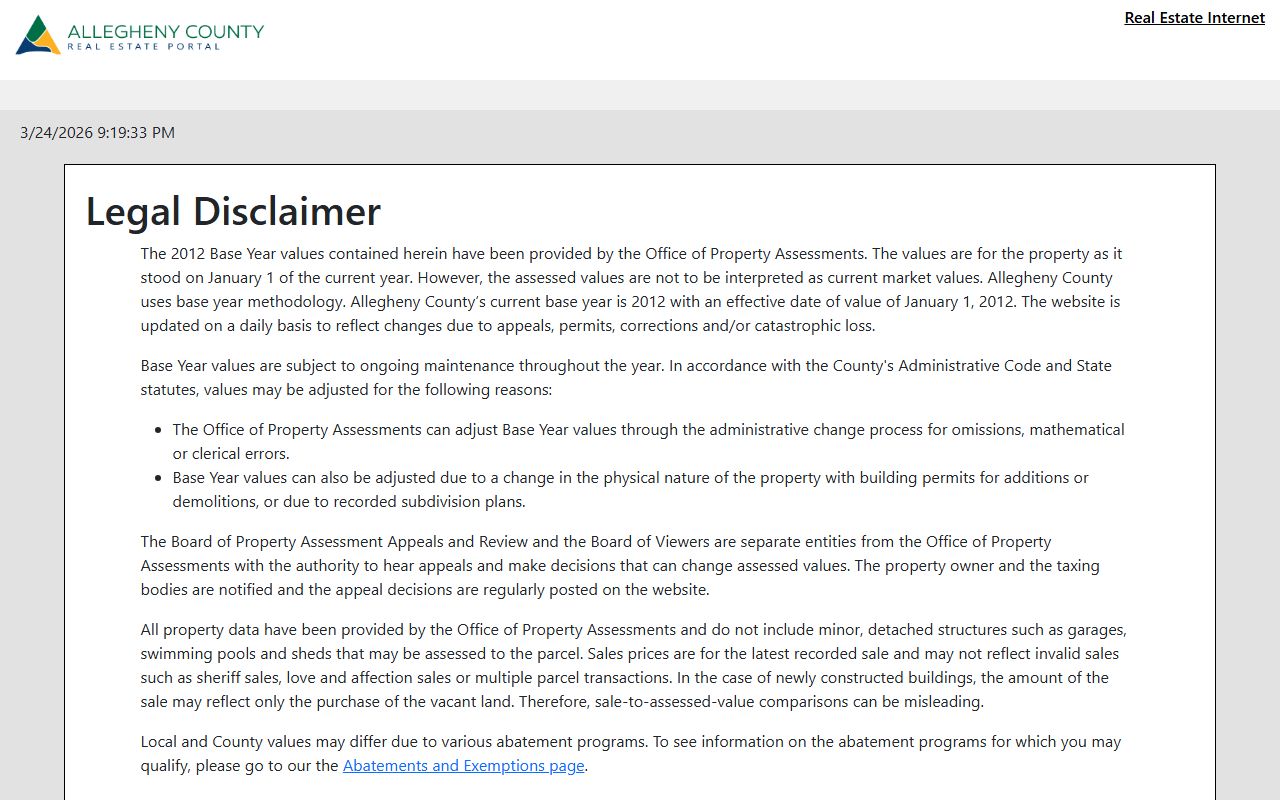
The real estate portal also links to assessment information, tax payment status, and property characteristics. This makes it a comprehensive starting point for anyone researching Allegheny County deed records or trying to understand the full ownership history of a Pittsburgh area property.
Allegheny County has more than 130 municipalities including boroughs, townships, and cities. The municipality map at apps.alleghenycounty.us lists each municipality with its district and representative details. Knowing the municipality helps when cross-referencing deed records with local zoning and permit records. The GIS viewer provides interactive mapping tools that display parcel boundaries and tax map data alongside the deed record index.
Note: The Allegheny County real estate portal is separate from the Recorder of Deeds document system. For certified copies of recorded deeds, contact the Recorder's office directly or visit the courthouse in Pittsburgh.
Allegheny County Recorder of Deeds
The Allegheny County Recorder of Deeds is located in Pittsburgh at the County Office Building. This office processes all new recordings, maintains the searchable index of past documents, and provides certified copies of recorded instruments. The Recorder's staff can help you find a deed by grantor or grantee name, book and page number, or property address. For complex property research in Pittsburgh or any other Allegheny County municipality, visiting the office in person gives you access to public terminals and staff assistance.
| Office | Allegheny County Recorder of Deeds |
|---|---|
| Address | County Office Building, Pittsburgh, PA 15219 |
| Online Access | alleghenycounty.us Real Estate Search |
| Statewide Portal | pa.uslandrecords.com |
Allegheny County also participates in Pennsylvania's e-recording system, which allows title companies, attorneys, and other approved filers to submit documents electronically. E-recording speeds up the recording process and reduces the need for in-person trips to the courthouse. Documents submitted electronically are processed and indexed in the same system as paper recordings. The statewide association of recorders at padeeds.com maintains a directory of county officials including the Allegheny County Recorder.
Recording Requirements in Allegheny County
Recording a deed in Allegheny County requires the document to meet Pennsylvania's formatting and content standards. The deed must name the grantor and grantee, include a legal description of the property, and be signed by the grantor before a notary public. A certificate of residence for the grantee is required under 16 P.S. § 9781. The document must also bear the property's Uniform Parcel Identifier (UPI) number.
Pennsylvania's realty transfer tax applies to most deed recordings in Allegheny County. The state imposes a 1% tax under 72 P.S. § 8102-C. Pittsburgh adds a local transfer tax of 4%, which is among the highest local rates in the state. For properties outside Pittsburgh, the local rate varies by municipality but is typically around 1%. Form REV-183, the Realty Transfer Tax Statement of Value, must accompany any deed subject to the tax. Certain transfers between family members, to trusts, or as part of corporate reorganizations may qualify for exemption under the Pennsylvania Department of Revenue rules.
The PRODA fee calculator at padeeds.com helps title professionals and property owners estimate the total cost to record a deed in Allegheny County. Recording fees depend on the number of pages in the document. First-page fees and per-additional-page fees vary. Allegheny County's recording staff can confirm current fee rates when you call or visit the office. All recorder offices microfilm every recorded document as a backup to digital storage.
Allegheny County Property Research Tips
Researching property in Allegheny County can involve many different systems. Start with the county's real estate portal for basic ownership and assessment data. Then move to the Recorder of Deeds index to find the actual deed documents and trace the chain of title. For older properties, historical deed books and microfilm records may be needed. FamilySearch holds some early Allegheny County land records in its digital collections, which can help with historical research going back to the county's formation in 1788.
Liens and judgments that affect Allegheny County properties may be recorded at the Prothonotary's office rather than the Recorder of Deeds. Municipal liens are handled separately from deed records. When researching a property's full legal status, check both offices. The Pennsylvania Right-to-Know Law at 65 P.S. § 67.101 ensures that Allegheny County deed records are public and available to anyone who requests them. Agencies must respond to formal requests within five business days, with a possible 30-day extension for complex requests.